MS and neurodegenerative diseases
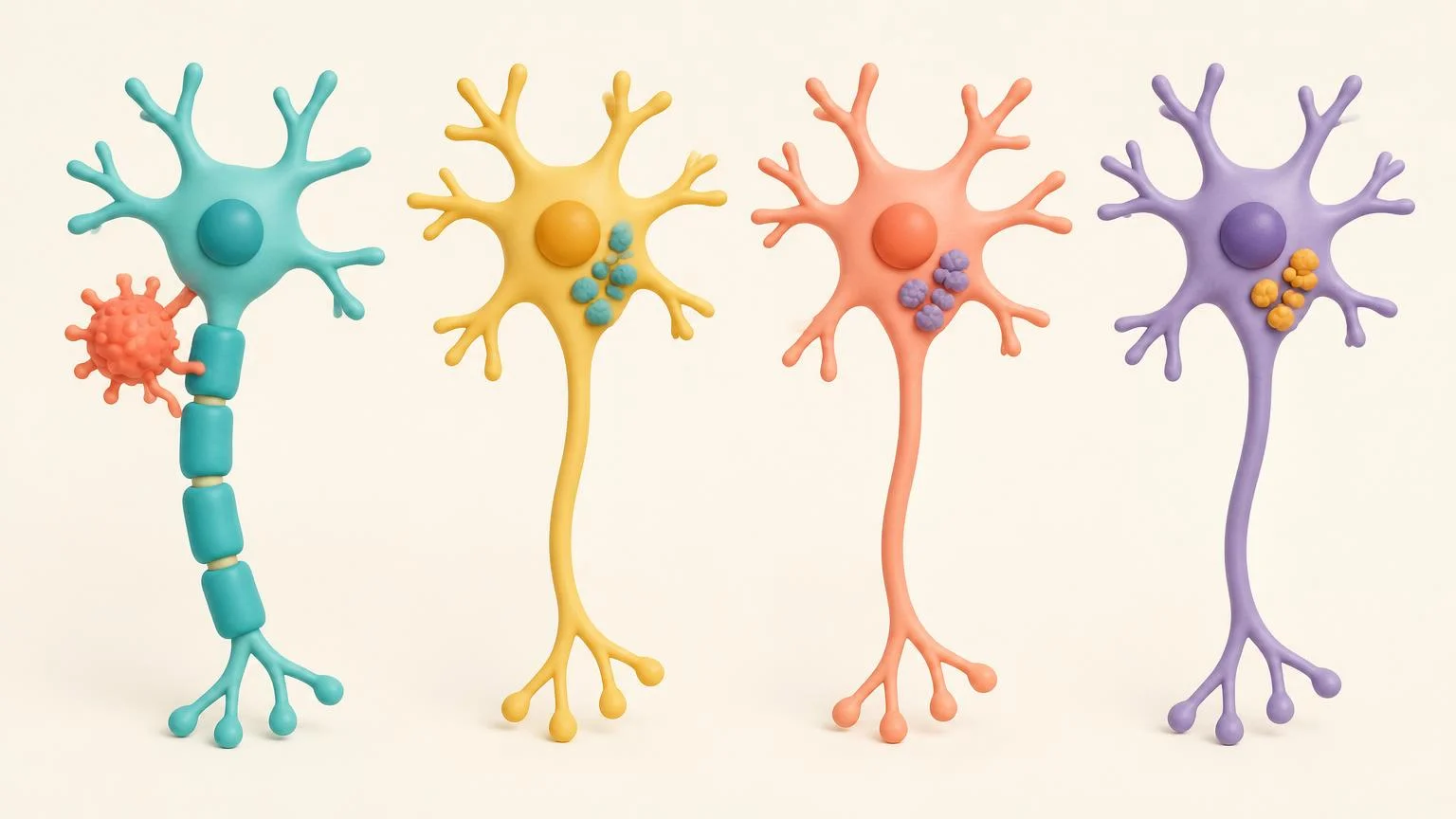
What "neurodegenerative" means
A neurodegenerative disease is one in which nerve cells are lost progressively over years. Alzheimer's disease, Parkinson's disease and amyotrophic lateral sclerosis (ALS, also called motor neurone disease) are the best known. Each begins in a different part of the nervous system, which is why their symptoms differ: memory and thinking in Alzheimer's, movement in Parkinson's, and the nerve cells that control muscles in ALS.
MS is usually described differently, as an immune-mediated disease, because it begins with the immune system attacking myelin. But nerve fibres and nerve cells are lost in MS too, and that loss, not the loss of myelin alone, is thought to cause most lasting disability (lesson 1.2). Progressive MS in particular shares features with the neurodegenerative diseases.
How they differ
- Usual onset 20 to 40
- Starts with an immune attack on myelin
- Lesions visible on MRI
- Many medicines prevent relapses.
The diseases start in different ways. In Alzheimer's disease, two proteins build up in the brain, amyloid beta in plaques outside nerve cells and tau in tangles inside them. In Parkinson's disease, the protein alpha-synuclein collects in clumps called Lewy bodies, first described as containing alpha-synuclein in 1997. In most cases of ALS, a protein called TDP-43 collects in the affected nerve cells, a finding made in 2006. In MS, no clumped protein of this kind drives the disease. Instead, immune cells enter the brain and spinal cord, strip myelin and leave lesions that can be seen on MRI.
They also affect different people. MS usually begins between the ages of 20 and 40, while Alzheimer's and Parkinson's diseases mostly begin after 60. MS has relapses that recover, at least at first. The neurodegenerative diseases progress steadily from the start.
What they share
As MS goes on, the processes that drive it come to resemble those of the neurodegenerative diseases. Inflammation settles inside the brain, microglia stay switched on, nerve fibres run short of energy, and repair fails more with age (lessons 3.2 and 4.2). Activated microglia, damaged mitochondria and the loss of the brain's resilience with ageing are studied in all of these diseases.
They also share a blood marker. Neurofilament light is released whenever nerve fibres are damaged, whatever the cause, and it rises in MS, ALS, Alzheimer's disease and many other conditions. It is therefore a sign of how much damage is happening, not of which disease is causing it.
What the fields have learned from each other
The fields borrow from each other's methods. MS trials made MRI lesion counts, and later blood neurofilament light, into standard measures, and neurofilament light is now measured in trials across neurology.
ALS gave an example of a blood marker supporting an approval. In the phase 3 trial of tofersen, an antisense medicine for people with ALS caused by mutations in the SOD1 gene, the main measure of function did not improve significantly over 28 weeks, but the medicine lowered SOD1 protein in spinal fluid and neurofilament light in blood. In 2023 the US regulator granted tofersen accelerated approval on the basis of the fall in neurofilament light. This is watched closely in MS, where trials of medicines for progression would be much faster if a blood marker could stand in for years of disability measures.
Alzheimer's disease shows how hard progress against a protein-driven disease has been. Antibodies that remove amyloid from the brain, such as lecanemab and donanemab, slowed decline on clinical scales in phase 3 trials, modestly, over about 18 months, with a risk of brain swelling and bleeding seen on MRI.
Why MS medicines do not work in these diseases
Most MS medicines act on immune cells in the blood and lymph nodes, which is where MS attacks begin. The neurodegenerative diseases are not started in that way, so these medicines have no clear reason to help, and they are not used for them. The overlap lies in the later, slower processes, and medicines aimed at those, such as treatments that act on microglia or protect mitochondria, are of interest across several of these diseases.
What we know
- Nerve cells and fibres are lost in MS as in the neurodegenerative diseases, and this loss drives lasting disability.
- MS begins with an immune attack, while Alzheimer's, Parkinson's and most ALS involve proteins that clump inside or around nerve cells.
- Neurofilament light rises in all of them and shows how much damage is happening, not which disease is causing it.
What we don't know
- How much progressive MS shares its mechanisms with the neurodegenerative diseases.
- Whether medicines that act on microglia or mitochondria can help in more than one of these diseases.
- Whether a fall in neurofilament light will be accepted as evidence that a medicine slows progressive MS.
In the research now
Loading current research…
Key terms
- Neurodegenerative disease
- A disease in which nerve cells are lost progressively over years, such as Alzheimer's, Parkinson's and ALS.
- Myelin
- The fatty sheath wrapped around many nerve fibres in the brain and spinal cord. It lets signals jump quickly along the fibre. MS damages it.
- Axon (nerve fibre)
- The long extension of a nerve cell that carries its signal. Losing axons, rather than myelin alone, is thought to cause most lasting disability.
- Microglia
- The resident immune cells of the brain and spinal cord. In MS they sustain slow inflammation at the edges of chronic lesions.
- Lesion (plaque)
- An area of damage where myelin has been lost and the tissue scarred.
- Relapse (attack)
- New or worsening symptoms lasting at least 24 hours, without fever or infection to explain them.
- Neurofilament light (NfL)
- A protein released when nerve fibres are damaged. Blood levels can rise with new inflammation and fall on effective treatment. Other conditions can also affect its level.
- Phase 1, 2 and 3
- The stages of testing in people: safety and dose, then an early sign of effect, then a large test of benefit.
References
- Spillantini MG, et al. α-Synuclein in Lewy bodies. Nature 1997. doi:10.1038/42166https://doi.org/10.1038/42166
- Neumann M, et al. Ubiquitinated TDP-43 in frontotemporal lobar degeneration and amyotrophic lateral sclerosis. Science 2006. doi:10.1126/science.1134108Further evidence on TDP-43 inclusions in most sporadic ALShttps://doi.org/10.1126/science.1134108
- Kuhlmann T, et al. Multiple sclerosis progression: time for a new mechanism-driven framework. Lancet Neurol 2023. doi:10.1016/S1474-4422(22)00289-7https://doi.org/10.1016/S1474-4422(22)00289-7
- Khalil M, et al. Neurofilaments as biomarkers in neurological disorders: towards clinical application. Nat Rev Neurol 2024. doi:10.1038/s41582-024-00955-xhttps://doi.org/10.1038/s41582-024-00955-x
- Miller TM, et al. Trial of antisense oligonucleotide tofersen for SOD1 ALS. N Engl J Med 2022. doi:10.1056/NEJMoa2204705https://doi.org/10.1056/NEJMoa2204705
- Biogen. FDA grants accelerated approval for QALSODY (tofersen) for SOD1-ALS. Press release, April 2023. https://investors.biogen.com/news-releases/news-release-details/fda-grants-accelerated-approval-Qalsodytm-Tofersen-sod1-alsOriginal FDA approval announcementhttps://investors.biogen.com/news-releases/news-release-details/fda-grants-accelerated-approval-Qalsodytm-Tofersen-sod1-als
- van Dyck CH, et al. Lecanemab in early Alzheimer's disease. N Engl J Med 2023. doi:10.1056/NEJMoa2212948https://doi.org/10.1056/NEJMoa2212948
- Sims JR, et al. Donanemab in early symptomatic Alzheimer disease: the TRAILBLAZER-ALZ 2 randomized clinical trial. JAMA 2023. doi:10.1001/jama.2023.13239https://doi.org/10.1001/jama.2023.13239
Next module · How treatments work
What a treatment has to do
A treatment for MS can aim at very different things, and evidence for one aim says little about another. This lesson explains the aims, how each is measured, how to read the size of an effect, and why every medicine is also a test of an idea about the disease.
Continue