What is multiple sclerosis?

The brain, spinal cord and myelin
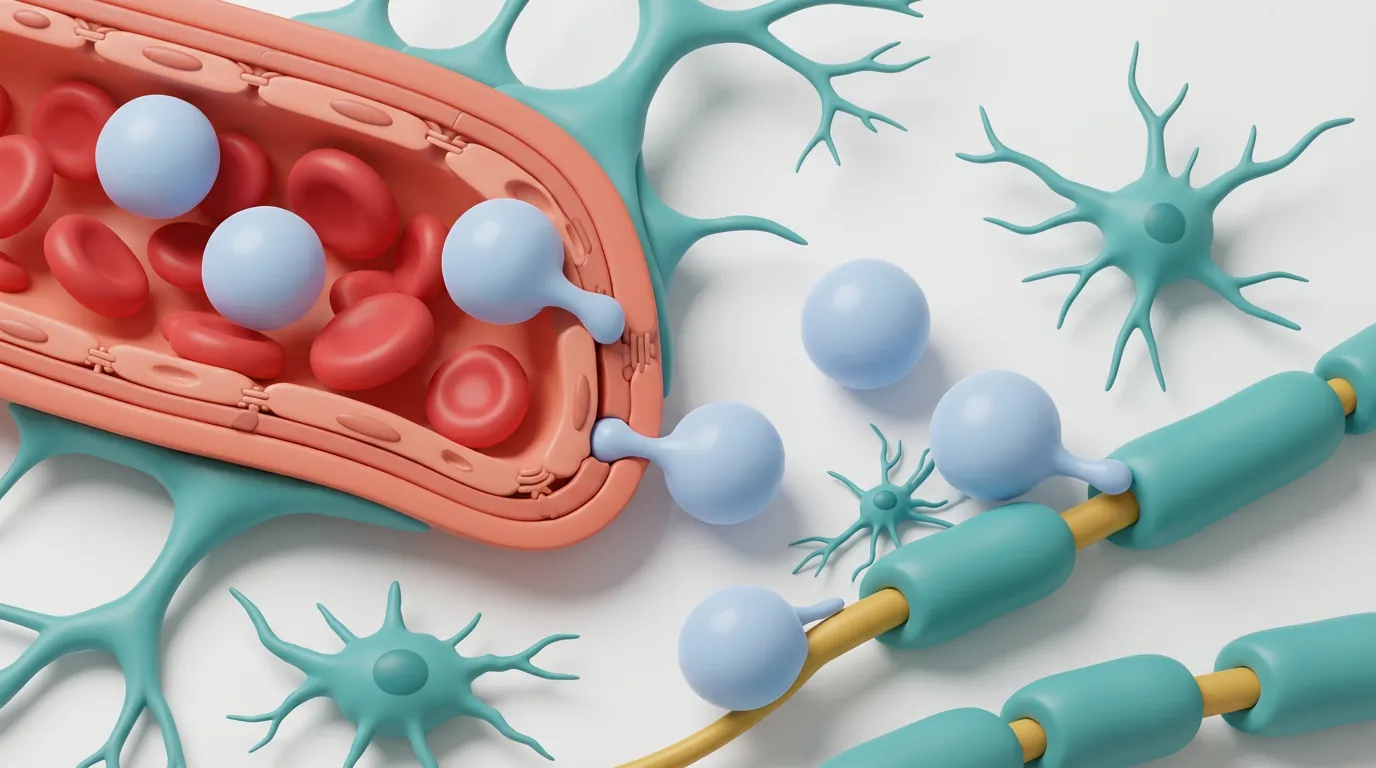
The brain and spinal cord form the central nervous system. Myelin is a covering around nerve fibres that helps signals travel efficiently. MS damages myelin and can also damage the underlying nerve fibres. Symptoms depend in part on which areas are affected.

Why symptoms differ
MS can affect movement, vision, sensation, balance and thinking, and fatigue is common. A list of possible symptoms is not a checklist for diagnosing MS: other conditions can cause similar problems.
Some people experience relapses followed by periods of recovery. Others have progressive worsening from the outset, or develop progression after a relapsing course. These descriptions do not predict an individual person’s future.
What causes MS?
The exact cause is not fully understood. MS involves an abnormal immune response, with genetic susceptibility and environmental factors contributing to risk. A family history does not mean that a person will develop MS.
Long-term studies point to the Epstein-Barr virus (EBV) as a major cause. Infection alone is not enough to cause MS, and how the virus leads to the disease is still being worked out.
Treatment and care have different goals
There is no cure yet. Relapsing MS can now often be well controlled, and research is working on progression and repair. Medicines that change the course of the disease, treatment for relapses, treatment for symptoms and rehabilitation each have a different purpose, and how much they help depends on the person and on the course of their MS.

In more depth
More than loss of insulation
Demyelination means loss or damage of myelin. MS also involves inflammation and injury to axons, the fibres that carry nerve signals. Damaged areas are often called lesions or plaques. The wiring analogy helps explain signal disruption, but it does not capture the full biology of inflammation, nerve injury and repair.
Disease course is not a biological boundary
Clinical course labels describe patterns over time. They are not separate diseases with entirely separate mechanisms. Relapse activity and disability progression are distinct dimensions, and progression can matter even in a disease course described as relapsing.
Common questions
Is MS directly inherited?
No. Genetic susceptibility contributes to risk, but MS does not follow a simple pattern of direct inheritance. Family history is one factor, not a diagnosis or a prediction.[1][2]
In the research now
Loading current research…
Key terms
- Myelin
- The fatty sheath wrapped around many nerve fibres in the brain and spinal cord. It lets signals jump quickly along the fibre. MS damages it.
- Axon (nerve fibre)
- The long extension of a nerve cell that carries its signal. Losing axons, rather than myelin alone, is thought to cause most lasting disability.
- Lesion (plaque)
- An area of damage where myelin has been lost and the tissue scarred.
- Relapse (attack)
- New or worsening symptoms lasting at least 24 hours, without fever or infection to explain them.
- Epstein-Barr virus (EBV)
- A common herpes virus that causes glandular fever. Infection appears to be almost necessary for MS, but most infected people never develop it.
References
- NINDS · Multiple sclerosis ↗
Medical reference
- NHS · Multiple sclerosis ↗
Medical reference
- Lublin et al. · Defining the clinical course of multiple sclerosis: the 2013 revisions (2014) ↗
Consensus
- Bjørnevik et al. · Longitudinal analysis of Epstein-Barr virus and MS (2022) ↗
Primary research
Next · Lesson 2 of 2
Myelin, axons and the cells that make them
Signals in the brain and spinal cord travel along nerve fibres wrapped in myelin. This lesson explains how that wrapping works, why the fibre underneath depends on it, and what happens to both in MS.
Continue