How machine learning is changing the way medicines are found and tested, and what it could mean for multiple sclerosis.
The short version
Artificial intelligence is becoming a practical research tool, not a replacement for the work of making and testing medicines. It can search large datasets, suggest disease targets, predict molecular structures and help researchers decide which experiments to do next. Its strongest achievements so far include useful predictions and candidates that can be tested, rather than a demonstrated cure for a complex disease.[5][3]
For MS, the important distinction is between discovering a new treatment and understanding the disease more precisely. AI researchers are working on both. Studies use scans and existing trial data to investigate progression, treatment response and biological differences between people. These studies can generate useful hypotheses, but they do not establish that following an algorithm improves a person’s health.[2]
None of the AI-discovered compounds discussed here is an approved MS treatment. Examples from lung disease or other conditions show that a discovery method can reach human testing. The results cannot be transferred to MS without appropriate studies. Current treatment decisions still depend on established clinical evidence and discussion with the treating team.[6][2][3]
How AI fits into drug development
Machine learning is software that learns patterns from examples. A model might learn which molecular features predict binding to a protein, or which combinations of scan findings are associated with subsequent disability. Generative models go further by proposing new designs. Neither kind of model understands a disease in the way a person does: its answers depend on the data, assumptions and task it was given.[3][5]
A medicine still has to pass through target selection, design, laboratory testing, clinical trials and regulatory assessment. These stages overlap and often involve returning to an earlier step. AI may reduce the work needed to explore candidates, but it cannot make a year of follow-up disappear or tell researchers about harms that were absent from its training data.[3]
1Choose a target
Look across genetics, gene activity and patient data for a biological process that might be changed by a medicine.
Finding an association is not the same as finding a cause. Target predictions need experiments that show why changing the target should help.[3]
2Design a molecule
Predict molecular structures, rank compounds or generate new chemical designs that could act on the target.
Structure prediction and computational design have produced experimentally testable candidates. A good fit alone does not establish treatment benefit.[5][6]
3Predict safety and behaviour
Estimate absorption, breakdown, clearance and possible toxicity before deciding which compounds to make.
Predictions can guide selection, but laboratory tests and human safety studies remain necessary. Rare or long-term harms may not be predictable.[3]
4Test in the laboratory
Make candidates, measure their effects and use the results to improve the next round of predictions.
Repeated measurement is essential. Cells and animal models cannot reproduce every feature of human disease, particularly progressive MS.[3][6]
5Run clinical trials
Explore patient selection, more consistent scan measurements and models of expected disease progression.
These methods need validation in the population and trial where they will be used. A prediction does not replace a reliable comparison of treatments.[2]
6Regulate and monitor
Evaluate whether a model is credible for its intended use and monitor the medicine or measurement tool after introduction.
FDA published draft, non-binding guidance in January 2025. FDA and EMA shared good-practice principles in January 2026. These are not an approval shortcut.[8][9]
Six overlapping stages of development, with the evidence needed at each. This is a schematic, not a ranking of proven time savings.
Different methods do different jobs
Protein-structure prediction estimates shape. Generative chemistry proposes molecules. Physics-based simulations estimate interactions, sometimes with machine learning. Target-discovery models look for patterns in biology. A digital twin predicts a person’s possible disease course. Calling all of these “AI-designed” hides important differences in what was actually done.[5][2][3]
The relevant test is not whether a programme used AI somewhere, but whether that particular use made a reliable difference. Researchers need to compare predictions with measured results, test the model on data it has not seen and report failures as well as successes. An apparent gain can disappear when a model moves to another hospital, scanner, population or laboratory.[3][2]
What has reached the laboratory and trials
Protein-structure prediction is a clear scientific achievement. AlphaFold 3 extended prediction to interactions involving proteins and other molecules. These structures can help researchers frame experiments and investigate possible binding sites. They are predictions, not a catalogue of medicines, and confidence differs between structures and tasks.[5]
Rentosertib provides a different kind of example: an AI-supported discovery programme reached a randomised human trial. The published pulmonary-fibrosis study reported safety findings and exploratory changes in forced vital capacity, a measure of lung function. The result is relevant to how candidates are discovered, not evidence that the same molecule or target would treat MS.[6]
AlphaFold 3
Lab/computational
Google DeepMind and Isomorphic Labs · Biomolecular research, not an MS treatment
Predicts structures of interacting proteins, nucleic acids and other molecules.
Published in Nature in 2024, with experimental structure comparisons.[5]
Evidence limit: A predicted structure is not an experimentally proven drug effect. Binding predictions do not establish efficacy or safety in people.
Rentosertib
Late-stage trial
Insilico Medicine · Idiopathic pulmonary fibrosis
AI supported selection of the TNIK target and design of the molecule.
A randomised phase 2a study of 71 participants was published in 2025. Insilico announced phase 3 first-patient dosing on 10 September 2026. The registry records a 9 September start. Planned enrollment is 320 participants in China, with 52 weeks of treatment.[6][10][11]
Evidence limit: The 12-week phase 2a study primarily assessed safety and explored lung-function effects. Phase 3 is a test, not proof of benefit. Neither study establishes benefit in MS.
Zasocitinib (TAK-279)
Late-stage trial
Nimbus / Schrödinger, now Takeda · Plaque psoriasis
A computational-discovery example in the brief. The precise contribution of AI versus other computational methods was not independently established in this source review.
Takeda announced on 14 September 2026 that FDA had accepted its application under priority review, with a Q1 2027 target action period. Its sponsor report says about 70% of zasocitinib-treated participants in the pivotal trials had clear or almost clear skin at week 16.[12][13]
Evidence limit: Under regulatory review, not approved in the cited announcement. The 70% figure concerns treated participants, not the entire development programme. The review period is sponsor-reported, not a regulator-confirmed calendar entry or a promised approval.
GB-0895
Late-stage trial
Generate:Biomedicines · Severe asthma
An anti-TSLP antibody described by the developer as AI-engineered, being tested for dosing every six months.
Two phase 3 studies, SOLAIRIA-1 and SOLAIRIA-2, are recruiting approximately 1,600 participants in total. Their estimated primary-completion dates are December 2028 and January 2029.[14][15][16]
Evidence limit: A dosing design is not evidence that six-monthly treatment works. Estimated study completion is not a confirmed public-results date. This is not an MS programme.
What has not been established
A 2024 analysis of AI-native biotechnology pipelines reported phase 1 success rates of 80 to 90% and approximately 40% in phase 2. The authors compared the first figure favourably with historical benchmarks, while phase 2 was comparable to historical performance. This limited observational analysis does not prove that AI caused better results, establish an observed approval rate or isolate target selection as the reason for failure.[7]
Better chemistry does not automatically solve uncertain biology. A compound may reach the intended protein, behave acceptably in the body and still fail to improve the disease. Disease mechanisms can differ between laboratory models and people, or between different groups of patients. Target validation therefore matters as much as the speed of molecule design.[3]
Industry comparisons of AI-discovered and conventional drug pipelines are difficult to interpret. Definitions differ, the number of completed programmes is small and unsuccessful programmes may be less visible. Historical averages also combine diseases, company types and trial designs that may not be comparable. Higher early-stage success rates would be encouraging, but would not by themselves prove that AI caused the improvement.[3]
Early safety findings do not establish long-term safety. Phase 1 commonly studies dose and tolerability, sometimes in healthy volunteers. Phase 2 explores dosing and evidence of benefit in a selected population. Phase 3 usually provides larger confirmatory comparisons, but a phase 3 trial can fail and an earlier randomised trial can already provide meaningful efficacy evidence. The phase number alone is not a verdict.[6][3]
Data quality is another limitation. Hospital records can be incomplete, scans vary between centres, and datasets may underrepresent older people, people with advanced disability or particular ethnic groups. A model can learn patterns of care or missing information rather than disease biology. Access to patient data also requires consent, governance and privacy safeguards, not simply an ambition to share everything openly.[2][3]
How to weigh the different perspectives
Developers emphasise the ability to search more possibilities and bring promising candidates into trials. Those are legitimate aims, but a sponsor has a financial interest in its programme. A press announcement can establish what the company says it has started. It is not independent evidence that a medicine works or that an estimate will be met.[6][3]
Scientific caution focuses on the gap between predicting a useful molecule and changing a complex disease. Both perspectives can be true: a method may improve one stage of development while leaving the hardest clinical questions unanswered. The most informative claims state the specific task, the comparison and the remaining uncertainty, rather than promising that AI will solve all diseases.[3]
For people with MS, a useful outcome would be better decisions and better treatments, especially for progression and repair. More accurate predictions are only a step towards that goal. Studies must establish whether acting on those predictions improves function, quality of life or safety, and whether the benefit applies beyond the population in which the model was developed.[2]
Where AI could make a difference in MS
The unmet needs in MS include slowing progression, protecting nerve fibres and repairing myelin, as well as controlling inflammatory activity. AI approaches address different parts of this problem and sit at different distances from clinical use. Measurement tools should not be confused with newly discovered treatments, and availability should not be confused with demonstrated improvement in patient outcomes.[4][2]
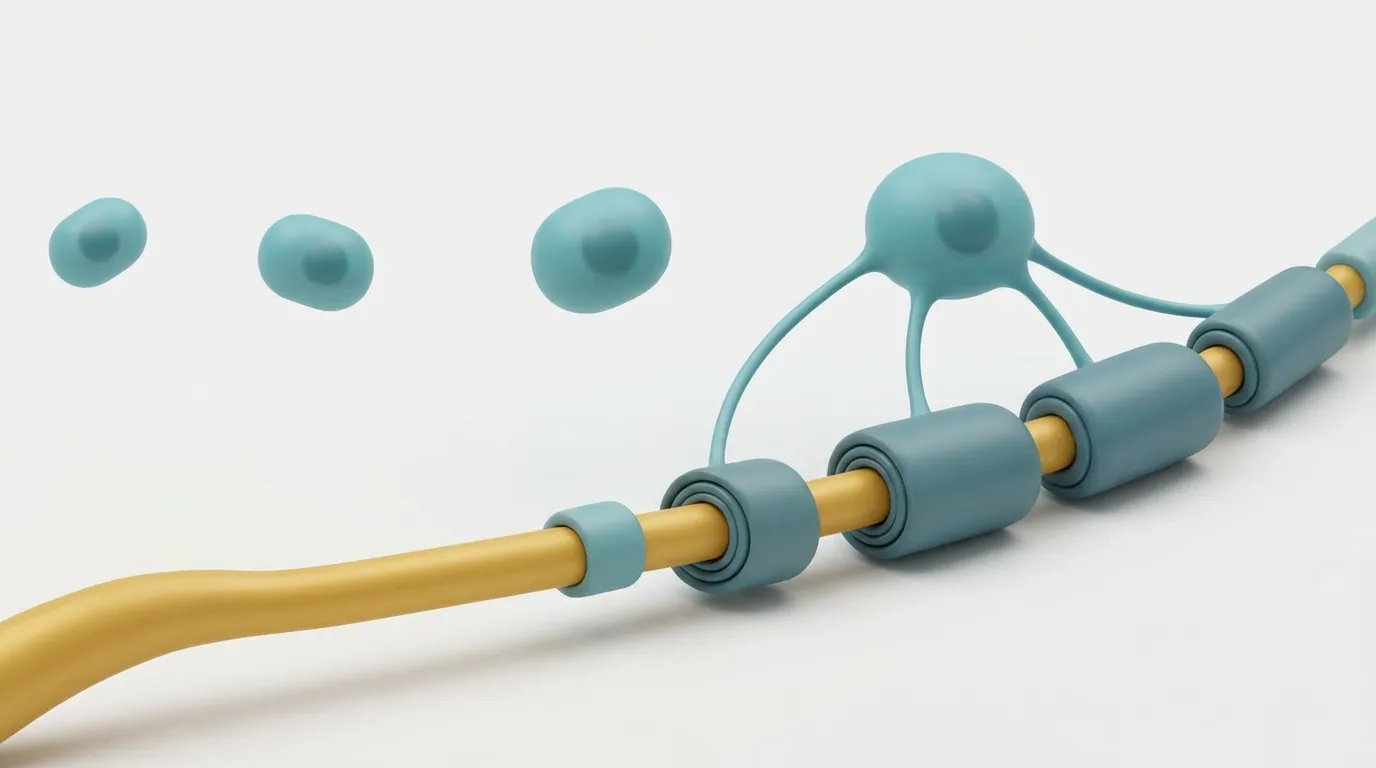
Myelin repair is one research goal. Illustration, not patient data or evidence of an AI treatment effect.[4]
Discovery and laboratory work
Repair targets, brain-penetrant compounds and repurposing candidates[21][22][28]
Research cohorts
Progression models and MRI or blood-marker disease patterns[2][17][18]
Trial methodology
Digital twins and proposed responder selection, not proven faster MS trials[20][29]
Clinical measurement
Quantitative MRI and proteomic disease-activity testing, not AI-discovered MS medicines[24][25]
AI approaches in MS by evidence setting, not a predicted timetable to patients. Use in measurement does not establish improved health outcomes.
Repairing myelin and protecting nerve fibres
Computational searches can propose targets in myelin-forming cells and molecules to test against them. For an MS drug, researchers must also consider whether enough of the compound reaches the brain and spinal cord. Success in a cell assay does not establish repair of an injured nerve or recovery of function in a person.[4][3]
In January 2026, Evogene and Unravel announced a collaboration to design and validate brain-penetrant compounds against a target identified through Unravel’s platform. The companies describe a remyelination objective. Their announcement does not disclose a named clinical MS candidate or demonstrate repair in people. This is a discovery programme, not a treatment option.[21]
Progressive MS presents additional difficulties: chronic inflammation, accumulated nerve injury and impaired repair may interact. An effective candidate needs appropriate experimental validation, including evidence about the relevant human disease mechanisms. A remyelination marker alone is not a substitute for a sustained, meaningful improvement in daily life.[4][1]
Predicting progression and treatment response
A 2022 deep-learning study estimated individual treatment effects on disability progression using existing clinical-trial data. This is a way to investigate whether people differ in their likely response, not proof that a model can choose the best treatment for an individual in routine care.[2]
Progression independent of relapse activity, or PIRA, is especially important because disability can accumulate without an obvious relapse. Prediction research needs clear outcome definitions, independent validation and enough follow-up. A risk score should also be tested for whether it changes care helpfully rather than only separating higher-risk and lower-risk groups.[1][2]
Rethinking disease patterns
A 2021 MRI study trained on 6,322 people inferred three patterns: cortex-led, normal-appearing-white-matter-led and lesion-led. It validated the patterns in a separate group of 3,068 people. The lesion-led subgroup showed positive treatment responses in selected retrospective trial analyses. This does not mean other people cannot benefit from treatment.[17]
A separate 2025 study combined MRI with serum neurofilament light chain, a blood marker of nerve injury. It identified early-sNfL and late-sNfL patterns in 189 training participants and 445 external-validation participants. These describe inferred sequences of abnormalities, not two definitive biological diseases or a clinically proven prescribing rule.[18]
Another 2025 international study used approximately 8,000 trial participants, 118,000 visits and more than 35,000 MRI scans to describe eight disease states. The collaboration, with first authors at Oxford and Novartis, validated the states in an independent trial database and a real-world cohort. These studies investigate MS as a changing process. They have not established that replacing current clinical classifications improves outcomes in routine care.[19]
Measuring disease and shaping trials
Models can extract patterns from MRI or combine clinical measurements to describe disease more consistently. They may help identify trial populations or estimate expected progression. Their value depends on reproducibility, uncertainty and suitability for the specific clinical question, rather than on the AI label.[2][3]
The icobrain software family first received FDA clearance in August 2016 for quantitative brain-image analysis. That is clearance of a measurement tool, not approval of autonomous diagnosis or AI-selected MS treatment. Octave’s 18-protein disease-activity assay has published clinical validation. A retrospective study reported changes in clinical decisions after testing, not proven long-term health improvements.[24][25][26]
An Unlearn preprint used 2,395 placebo-arm participants to simulate MS trial trajectories. On several tested measures, simulated and observed trajectories were statistically indistinguishable. This retrospective methodological finding is not proof of exact individual counterfactuals, equivalence or a successful smaller MS trial. The paper does not demonstrate that a trial finished sooner or needed fewer controls.[20]
A digital twin is a statistical prediction of what might happen to a participant, not another real patient. Predictions can support some trial analyses, but treatment allocation, confounding and model error still matter. A modelled control group cannot simply be assumed to replace a randomised comparison or make a smaller study equally reliable.[2][3]
Finding new uses for existing medicines
Repurposing asks whether a compound studied or used for another condition might address an MS mechanism. Computational tools can prioritise candidates from a large list. Existing information about dosing or safety can be useful, but a different population, combination or duration may introduce new risks. Efficacy in MS still needs to be tested.[3][4]
The MS Society and Medicines Discovery Catapult describe a machine-learning search that identified approximately 300 additional candidates for investigation. These are not 300 effective MS drugs or 300 compounds already entering trials. Cantex and Headlamp’s 2026 collaboration similarly plans to investigate responder subtypes for azeliragon development in MS-related depression and fatigue. The announcement is not proof of successful selection or symptom benefit.[28][29]
Finding targets in patient data
In February 2026, Merck & Co., known as MSD outside the US and Canada, and Mayo Clinic announced an AI-enabled discovery collaboration initially including MS. The agreement aims to combine multimodal patient data with computational capabilities to improve disease understanding and target identification. It does not report a validated MS target, resulting medicine or proven reduction in development time.[22]
Who is working on it
AI work in MS spans academic groups, charities, health systems and companies. The examples below are selected for identifiable research or programmes, not as a ranking or endorsement. Their stages differ: a data-building project, an analysis of historical trials and a commercial measurement tool are not equivalent to a treatment trial.[2][3]
Evogene and Unravel Biosciences
Lab/computational
Sponsor-announced discovery programme for brain-penetrant compounds in demyelinating disorders. Clinical repair remains unproven.[21]
Merck & Co. / MSD and Mayo Clinic
Lab/computational
Research collaboration for AI-enabled discovery and precision medicine, initially including MS.[22]
UCL and international collaborators
Research cohorts
MRI and blood-marker disease-pattern modelling, with retrospective validation.[17][18]
Oxford / Novartis-led international collaboration
Research cohorts
Eight-state model describing MS as a continuum using historical clinical-trial data.[19]
Progressive MS Alliance, McGill and Mila
Research cohorts
The Alliance funds a causal deep-learning project investigating progression and treatment response from MRI. These are research goals, not a delivered prescribing tool.[27]
CLAIMS consortium
Research cohorts
RECLAIM protocol for harmonising retrospective multicentre data and developing prognostic models.[23]
Unlearn
Methodology
Retrospective MS digital-twin methodology reported in a preprint, without demonstrated replacement of randomised controls.[20]
MS Society and Medicines Discovery Catapult
Lab/computational
Computational prioritisation of possible repurposing candidates for further investigation.[28]
icometrix
Clinical measurement
Quantitative MRI software family with FDA clearance for measurement rather than treatment discovery.[24]
Octave Bioscience
Clinical measurement
Commercial proteomic disease-activity test with published clinical validation, but no demonstrated disability benefit.[25][26]
Cantex and Headlamp Health
Methodology
Sponsor-announced investigation of responder subtypes to inform azeliragon development for depression and fatigue in MS.[29]
McGill and collaborators
Research cohorts
Deep-learning estimates of treatment effects from MS clinical-trial data.[2]
What to watch next
The most useful milestones are published clinical results, independently validated models and evidence that a research tool improves real decisions. Company timelines are plans, not promises. A filing, a trial start and a regulatory approval are different events, and results in another disease do not establish benefit in MS.[3][6]
For MS specifically, watch for experimentally validated repair targets, named candidates that enter human testing, progression models validated in independent clinics and trials that prospectively test AI-informed selection or analysis. A stronger claim would report an improvement in patient outcomes compared with current practice, not just better performance on a prediction benchmark.[2][4][3]
2024 · Published result
Biomolecular structure prediction
AlphaFold 3 paper reports predictions of interactions involving proteins and other molecules.[5]
2025 · Published result
Rentosertib in pulmonary fibrosis
Randomised phase 2a results published. This is not an MS medicine.[6]
September 2026 · Sponsor announcement
Rentosertib phase 3 dosing
Insilico reports first-patient dosing in GENESIS-IPF-3. The trial tests efficacy and safety. It does not establish them.[10][11]
Q1 2027 · Sponsor announcement
Zasocitinib review target
Takeda reports a target action period. This is not a regulator-confirmed date or a guarantee of approval, and the medicine is not for MS.[12]
December 2028 / January 2029 · Registry estimate
GB-0895 primary completion
Estimated completion of primary outcome collection in the two asthma studies, not confirmed dates for public results.[15][16]
October 2029 · Registry estimate
Rentosertib primary completion
Estimated primary completion of GENESIS-IPF-3, not an approval forecast.[11]
No established date · Open research question
MS treatment benefit from AI
Prospective evidence is needed that an AI-informed strategy improves outcomes in people with MS.[2][3]
Published milestones and open questions. Sponsor plans are not regulator-confirmed decision dates.
Five questions for an “AI drug” headline
1. What did AI actually do?
Identify a target, design a molecule, analyse scans or help one other step?
2. What evidence stage is it at?
A computational prediction, laboratory experiment, human trial or regulatory assessment?
3. What changed for patients?
A biomarker or prediction score is not the same as better function, quality of life or survival.
4. Who reports it?
Distinguish a sponsor announcement, preprint and peer-reviewed result, and look for an appropriate comparison.
5. Is the study about MS?
A discovery method may transfer between diseases, but treatment benefit does not transfer without testing.
Glossary
Artificial intelligence
An umbrella term for computer methods used to recognise patterns, make predictions or generate designs.
Machine learning
Methods that learn patterns from data rather than relying only on hand-written rules.
Generative AI
Models that propose new outputs, such as candidate molecular structures.
Target
A biological molecule or process that a treatment aims to change.
Small molecule
A relatively small chemical compound. Some can enter cells or the brain, but this must be tested.
Antibody
A protein that binds a particular target. Therapeutic antibodies are usually injected or infused.
Phase 1, 2 and 3
Broad stages exploring safety and dose, evidence of activity and benefit, and larger confirmatory comparisons. Their exact design varies.
Repurposing
Investigating a medicine or compound for a different use.
Digital twin
A modelled prediction of a participant’s possible course under a specified scenario.
Remyelination
Rebuilding myelin around nerve fibres.
PIRA
Progression independent of relapse activity: confirmed disability worsening outside defined relapse-associated periods.
Blood-brain barrier
A selective barrier between the blood and the central nervous system that influences which substances enter.
This page explains research; it is not medical advice. None of the AI-discovered compounds mentioned here is an approved MS treatment.