Measuring MS
In short
Every trial depends on its measures: relapses, MRI scans, disability scores and, increasingly, blood markers.
Better measures make trials faster and fairer, and show whether a change on a scan means anything to the person.
Blood neurofilament light, new MRI signs of smouldering inflammation and better disability scales are being tested as ways to judge treatments sooner.
Measures in trials
Loading measures…
Counts are bank-wide. Links show trials with the matching main-measure tag for the selected type of MS.
Main measures over time
2000 to 2004 · 0 trials
2005 to 2009 · 0 trials
2010 to 2014 · 0 trials
2015 to 2019 · 0 trials
2020 to 2024 · 0 trials
2025 to 2026 · 0 trials
Share of all trials with a recorded start year. Other and unclassified main measures remain in the total.
Every trial depends on what it measures. Phase 3 trials in relapsing MS have mostly counted relapses, and those in progressive MS have counted disability worsening on the EDSS, a scale from 0 to 10 that depends heavily on walking.[1] Phase 2 trials usually count new lesions on MRI, because they respond to effective treatment within months.
These measures have limits. Disability often worsens without relapses: in a pooled analysis of the two large ocrelizumab trials in relapsing MS, most confirmed disability accumulation came from worsening independent of relapses.[2] The EDSS changes slowly and in coarse steps, so progression trials need hundreds of people followed for years.
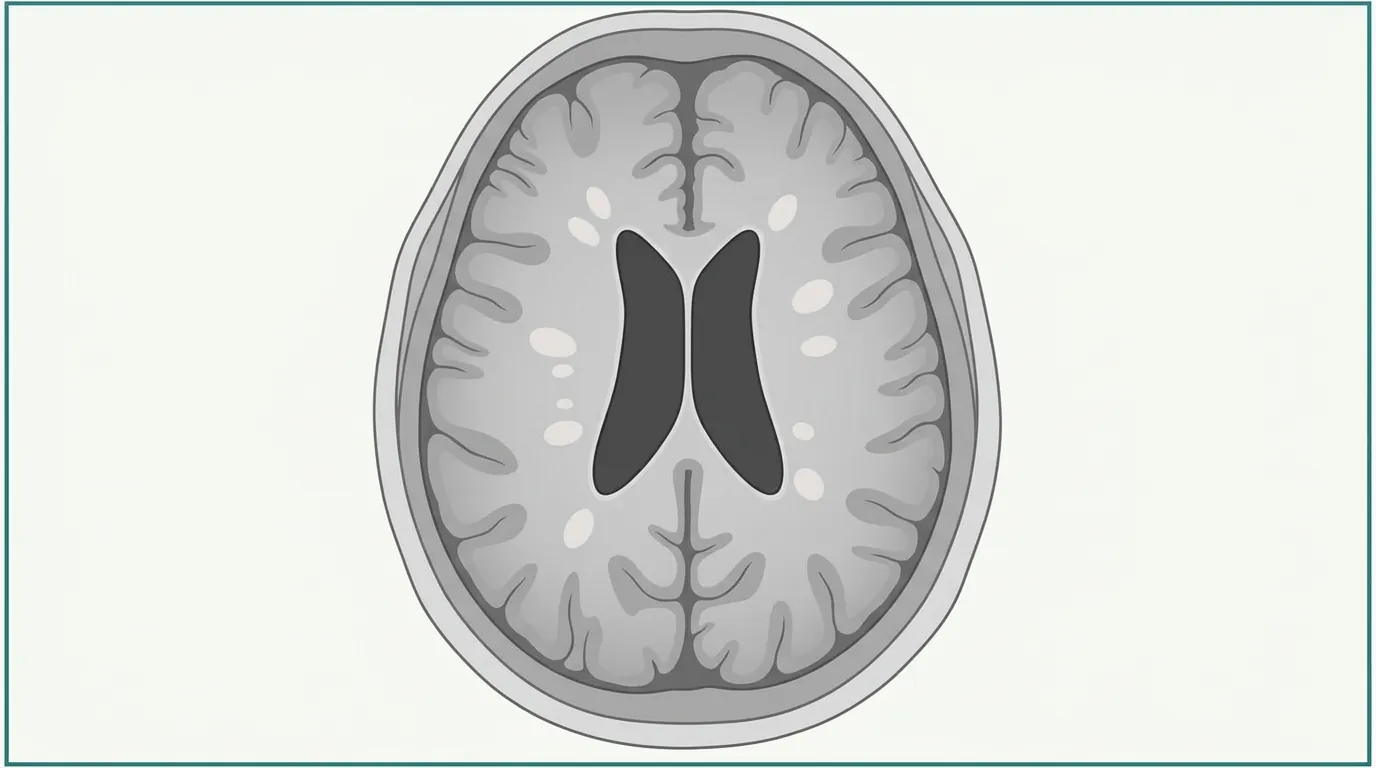
Newer measures aim to show damage sooner. Blood neurofilament light, interpreted against healthy people of the same age, predicted later relapses and new lesions in a large Swiss cohort.[3] Paramagnetic rim lesions and slowly expanding lesions on MRI mark inflammation that persists inside the brain and go with faster worsening.[4][5] Optical coherence tomography and evoked potentials measure damage and repair along the visual pathway.
None of these yet replaces a clinical measure as the main proof that a medicine works for people with MS. The open question is which changes on a scan or in the blood reliably predict what matters to a person, such as walking, using the hands, thinking and fatigue.
References
- 1.Kurtzke JF. Rating neurologic impairment in multiple sclerosis: an expanded disability status scale (EDSS). Neurology 1983. doi:10.1212/WNL.33.11.1444
- 2.Kappos L, et al. Contribution of relapse-independent progression vs relapse-associated worsening to overall confirmed disability accumulation in typical relapsing multiple sclerosis. JAMA Neurol 2020. doi:10.1001/jamaneurol.2020.1568
- 3.Benkert P, et al. Serum neurofilament light chain for individual prognostication of disease activity in people with multiple sclerosis. Lancet Neurol 2022. doi:10.1016/S1474-4422(22)00009-6
- 4.Absinta M, et al. Association of chronic active multiple sclerosis lesions with disability in vivo. JAMA Neurol 2019. doi:10.1001/jamaneurol.2019.2399
- 5.Elliott C, et al. Slowly expanding/evolving lesions as a magnetic resonance imaging marker of chronic active multiple sclerosis lesions. Mult Scler 2019. doi:10.1177/1352458518814117
Background in MS in depth
- 4.2 · Relapses, PIRA and NEDA
- 5.2 · How MS is diagnosed
- 5.3 · Spinal fluid, oligoclonal bands and kappa free light chains
- 6.1 · How MRI shows MS
- 6.2 · Rims, central veins and atrophy
- 7.1 · How MS is measured
- 7.2 · Neurofilament light and GFAP
- 7.3 · OCT and evoked potentials
- 10.1 · Conditions that resemble MS
- 10.3 · MS and neurodegenerative diseases
Assembled by software from public sources and not checked by people. Each record links to its source. Report an error