Stopping inflammation
In short
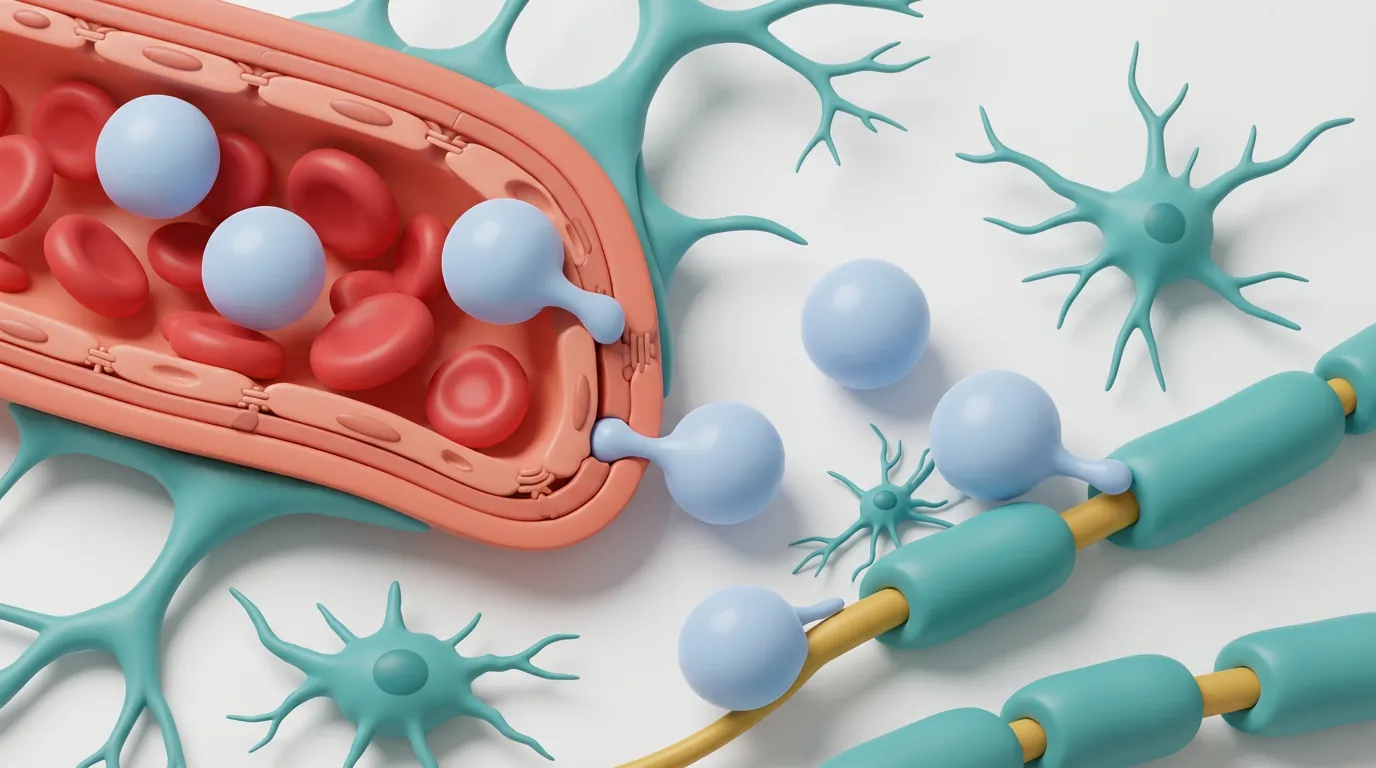
Relapses and new lesions come mainly from immune cells that travel from the blood into the brain and spinal cord.
Stopping them prevents the damage each attack leaves behind, and it is where treatment has advanced most.
Several medicines now prevent most relapses in many people. The open questions are safety, cost, how long to treat and whether early, strong treatment changes the long-term course.
Hypotheses by status
- Confirmed 9
- Supported by one trial 2
- Promising 1
- Mixed 4
- Results pending 18
- Being tested 42
- Failed early 11
- No clear answer 45
- 132
- Hypotheses
- 32
- Trials recruiting
- 38
- Phase 3 running
- 4
- Readouts in 90 days
Most recent results
- Phase 3Main goal metvs placebo2026
- Phase 3Main goal metvs placebo2026
- Phase 2Main goal not metvs placebo2026
Next readouts
Nov 2026
cyclophosphamide anhydrous
Jan 2027
metformin
Jan 2027
dimethyl fumarate, diroximel fumarate, glatiramer acetate
Relapses and new lesions come mostly from immune cells that travel from the blood into the brain and spinal cord. Medicines that block their entry, keep them in the lymph nodes or remove them can now prevent most relapses in many people. In AFFIRM, natalizumab reduced the annualised relapse rate by 68 per cent compared with placebo. In OPERA I and II, ocrelizumab reduced the annualised relapse rate by 46 and 47 per cent compared with interferon beta-1a.[1][2]
The open questions are about doing this more safely, more cheaply and for longer. Trials compare effective medicines head to head, test whether treatment can be reduced or stopped in stable older patients, and measure whether early, strong treatment changes the long-term course. Lower relapse rates and effective existing treatments make new trials harder to design. Observed relapse rates in placebo groups have fallen across trials, but changes in the people recruited and in trial design may explain much of the difference. Older and newer trials therefore cannot be compared directly.[3]
Stopping relapses does not by itself stop progression. That question has its own frontier.
Choosing between effective medicines.
Most trials of new relapse medicines now compare them with an existing medicine rather than with placebo, because placebo is hard to justify when effective treatment exists. Direct comparisons between the most effective medicines are rarer and often small. REVEAL, which compared natalizumab with fingolimod, was stopped early because too few people joined, and its main question could not be answered.[4] Large trials now running ask a broader question: whether starting with a highly effective medicine leads to a better course over years than starting with a milder one and escalating. The Trial Bank lists them under early high-efficacy treatment.
Stopping treatment.
Many people take a disease-modifying medicine for decades, and relapses become rarer with age. The DISCOMS trial randomly assigned 259 people aged 55 or over, without relapses for five years and without new MRI lesions for three, to continue or stop their medicine. Within two years, 4.7 per cent of those who continued and 12.2 per cent of those who stopped had a relapse or a new MRI lesion. The trial could not show that stopping was as safe as continuing, but most of the new activity was one or two MRI lesions without symptoms.[5]
Safety over decades.
The most effective medicines act broadly on the immune system, so their risks matter as much as their benefits. Natalizumab can allow a rare brain infection, progressive multifocal leukoencephalopathy, and B-cell depletion lowers antibody responses to vaccines and some infections. Trials and registries that follow people for many years are how these risks are measured. The Medicines pages list the safety communications for each medicine.
References
- 1.Polman et al. AFFIRM. NEJM (2006)
- 2.Hauser et al. OPERA. NEJM (2017)
- 3.Steinvorth et al. Temporal trends in annualised relapse rates. Multiple Sclerosis Journal (2013)
- 4.Butzkueven H, et al. Natalizumab versus fingolimod for patients with active relapsing-remitting multiple sclerosis: results from REVEAL, a prospective, randomised head-to-head study. BMJ Open 2020. doi:10.1136/bmjopen-2020-038861
- 5.Corboy JR, et al. Risk of new disease activity in patients with multiple sclerosis who continue or discontinue disease-modifying therapies (DISCOMS): a multicentre, randomised, single-blind, phase 4, non-inferiority trial. Lancet Neurol 2023. doi:10.1016/S1474-4422(23)00154-0
Assembled by software from public sources and not checked by people. Each record links to its source. Report an error