Repair and protection
In short
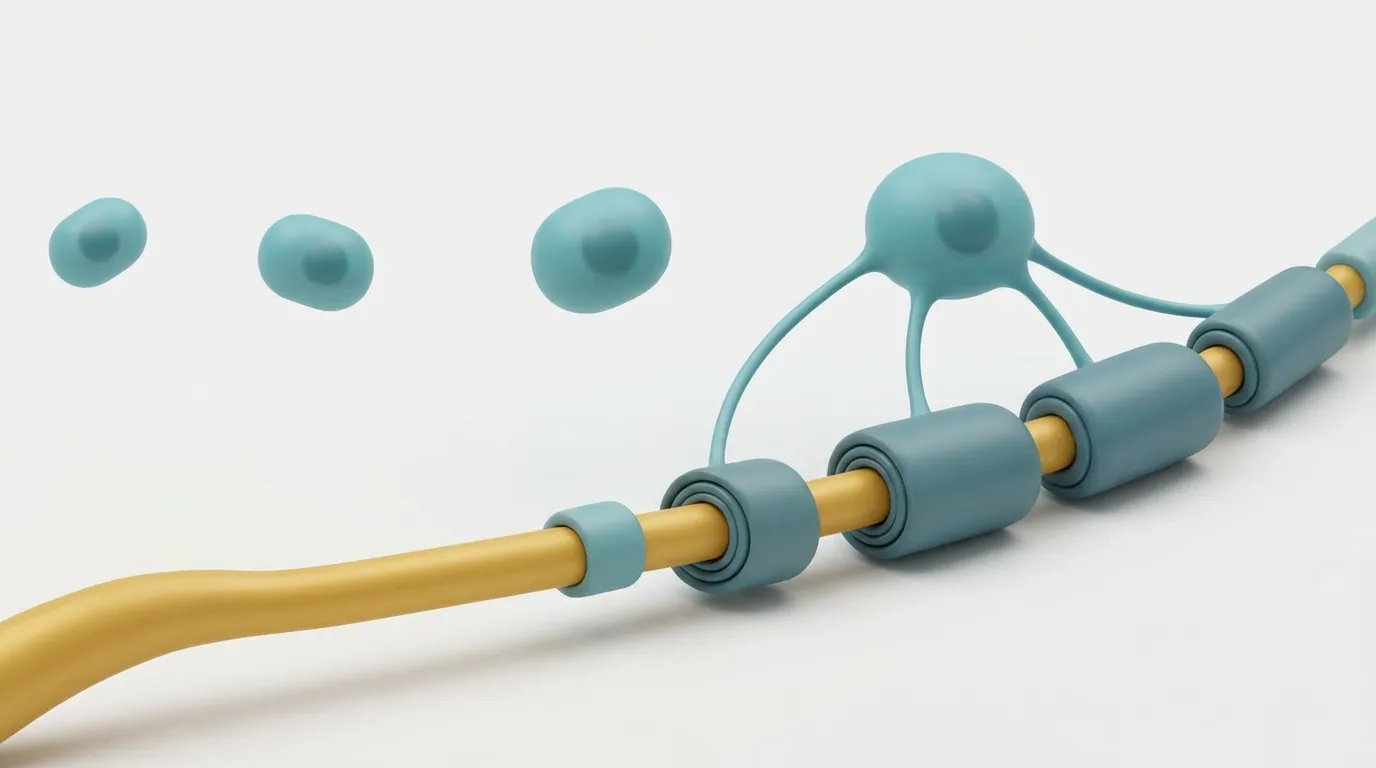
The brain can rebuild lost myelin, but in MS the repair often stalls, and nerve fibres that lose their myelin can die.
Repairing myelin or protecting nerve fibres is the only route to restoring function that has been lost.
Early trials have shown that repair can be measured in people. None has yet shown a lasting gain in everyday function.
Hypotheses by status
- Promising 7
- Mixed 1
- Results pending 13
- Being tested 40
- Failed early 9
- Disproven 1
- No clear answer 38
- 109
- Hypotheses
- 17
- Trials recruiting
- 6
- Phase 3 running
- 0
- Readouts in 90 days
Most recent results
- Phase 2Main goal not metvs placebo2026
- Phase 2Stopped: no effectvs placebo2025
- Phase 3Main goal not metvs placebo2025
Trials to watch
Loading trials to watch…
All trials to watch →Repairing myelin and protecting nerve fibres
Repair and protection are complementary goals: rebuilding myelin may help surviving nerve fibres work better, while neuroprotection aims to prevent those fibres being lost.[1][8]
In the small ReBUILD trial, clemastine shortened the delay in signals along the visual pathway, a finding consistent with remyelination. It was evidence of a repair-related effect in people, although it did not show an improvement in everyday function.[2]
In laboratory studies, metformin restored remyelination capacity in aged animals. Cambridge’s preliminary conference report from CCMR-Two described stable visual-evoked-potential signal speed with metformin plus clemastine while it slowed on placebo over six months. Participants did not report feeling better, and the results do not show a long-term effect on disability.[3][9]
Results also depend on the population and safety cannot be assumed from a medicine’s previous uses. In the small, non-randomised clemastine arm of TRAP-MS, three of nine participants with follow-up met disability-worsening safety stopping criteria and the arm was closed. The different populations and designs must be considered alongside ReBUILD. It is a serious warning, although the arm was too small to estimate the risk for everyone with MS.[10][2]
Neuroprotection addresses a different part of the problem: energy supply, mitochondrial dysfunction and the survival of demyelinated axons. A repair strategy may need to be combined with control of inflammation and protection of nerve fibres, because replacing myelin cannot bring back an axon that has already been lost.[1][8]
Some plausible neuroprotective approaches have not succeeded. In MS-SMART, none of amiloride, fluoxetine or riluzole significantly improved the primary MRI brain-volume endpoint versus placebo over 96 weeks. An open-label CNM-Au8 study investigated brain energy metabolites in a small group of people with MS. Showing that a medicine reaches its target in the brain is not the same as showing that it protects against disability.[6][7]
Opicinumab, an antibody designed to release a brake on repair, did not improve disability in the SYNERGY trial, and high-dose biotin did not help people with progressive MS in the SPI2 trial.[4][5]
References
- [1]Mahad, Trapp and Lassmann. Pathological mechanisms in progressive multiple sclerosis. Lancet Neurology, review (2015)
- [2]Green et al. Clemastine fumarate as a remyelinating therapy for multiple sclerosis (ReBUILD). Lancet, 2017
- [3]Neumann et al. Metformin restores CNS remyelination capacity by rejuvenating aged stem cells. Cell Stem Cell, 2019
- [4]Cadavid et al. · Opicinumab in relapsing MS (SYNERGY), Lancet Neurology (2019)
- [5]Cree et al. · High-dose biotin in progressive MS (SPI2), Lancet Neurology (2020)
- [6]Chataway et al. Efficacy of three neuroprotective drugs in secondary progressive multiple sclerosis (MS-SMART): a phase 2b, multiarm, double-blind, randomised placebo-controlled trial. Lancet Neurology (2020)
- [7]Ren et al. Evidence of brain target engagement in Parkinson’s disease and multiple sclerosis by the investigational nanomedicine, CNM-Au8, in the REPAIR phase 2 clinical trials. Journal of Nanobiotechnology (2023)
- [8]Bebo et al. Pathways to cures for multiple sclerosis: a research roadmap (2022)
- [9]University of Cambridge. Diabetes drug and antihistamine could together repair multiple sclerosis damage, trial finds (CCMR-Two preliminary conference report, 2025)
- [10]Kocot et al. Clemastine fumarate accelerates accumulation of disability in progressive MS by enhancing pyroptosis. JCI (2025)
Assembled by software from public sources and not checked by people. Each record links to its source. Report an error