Related diseases: NMOSD and MOGAD
In short
NMOSD and MOGAD are separate diseases that can look like MS. Each is usually driven by a known antibody.
Knowing the cause has made targeted medicines possible, and some MS medicines can make NMOSD worse.
Several medicines now prevent attacks in NMOSD. Trials in MOGAD are under way.
Hypotheses by status
- Confirmed 3
- Results pending 4
- Being tested 13
- No clear answer 18
- 38
- Hypotheses
- 13
- Trials recruiting
- 13
- Phase 3 running
- 4
- Readouts in 90 days
Most recent results
No full results recorded yet.
Few results have been reported here recently.
Next readouts
Dec 2026
eculizumab
Dec 2026
azathioprine
Dec 2026
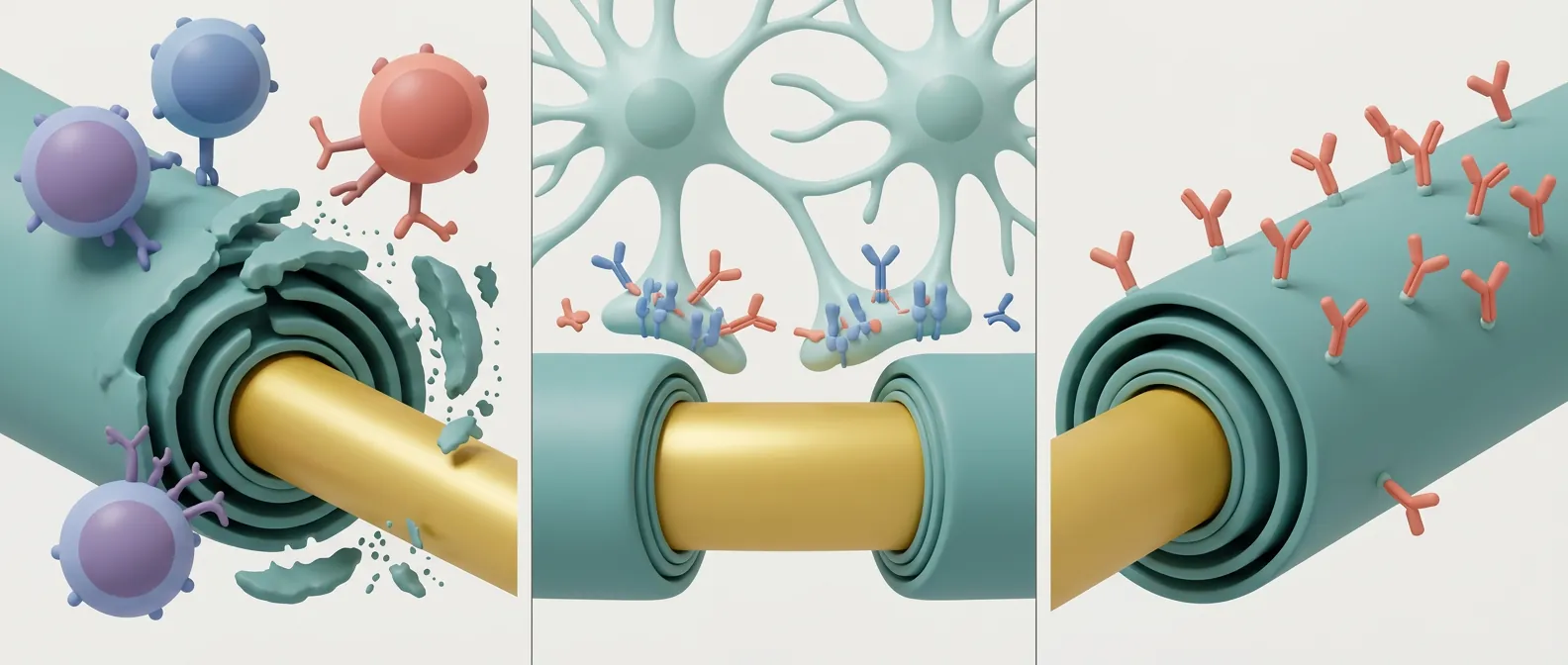
NMOSD and MOGAD are not forms of MS. They are separate diseases of the brain, spinal cord and optic nerves, each usually caused by a known antibody, and they are treated differently. They are included here because they were long confused with MS, and because what was learned from them is relevant to MS research.
A disease with a known target
In most people with NMOSD, the immune system makes antibodies against aquaporin-4, a water channel on astrocytes. The antibody was identified in 2004 and 2005, and it turned a condition long treated as a variant of MS into a separate disease.[1][2]
Medicines built around the antibody
Each of the new medicines blocks a different step between the antibody and the damage. Eculizumab blocks complement, the part of the immune system that the antibody sets off to destroy astrocytes. Inebilizumab removes B cells through CD19, which is found on a wider range of B cells than CD20, including some that make antibodies. Satralizumab blocks interleukin-6, a signal that helps antibody-making cells survive. In their trials, all three reduced attacks compared with placebo. The evidence is strongest for NMOSD with aquaporin-4 antibodies, and does not establish equal benefit in people without them.[3][4][5]
Why some MS medicines can harm
Some medicines that help in MS can make NMOSD worse. In one series, people with NMOSD who were treated with interferon beta had more attacks and higher antibody levels. This is one reason telling the two diseases apart before treatment matters.[6]
MOGAD
MOGAD, defined by antibodies against myelin oligodendrocyte glycoprotein, received its own diagnostic criteria in 2023. Trials of medicines for it are under way, and the Trial Bank lists them.[7]
What this teaches about MS
In MS no single target like aquaporin-4 has been found, so its medicines act broadly on immune cells. If such a target were found, the history of NMOSD suggests that far more precise medicines could follow.[1]
References (7)
- 1. Lennon et al. · A serum autoantibody marker of neuromyelitis optica: distinction from multiple sclerosis. Lancet (2004)
- 2. Lennon et al. · IgG marker of optic-spinal multiple sclerosis binds to the aquaporin-4 water channel. Journal of Experimental Medicine (2005)
- 3. Pittock et al. · Eculizumab in aquaporin-4-positive neuromyelitis optica spectrum disorder (PREVENT). NEJM (2019)
- 4. Cree et al. · Inebilizumab for the treatment of neuromyelitis optica spectrum disorder (N-MOmentum). Lancet (2019)
- 5. Yamamura et al. · Trial of satralizumab in neuromyelitis optica spectrum disorder (SAkuraSky). NEJM (2019)
- 6. Palace et al. · Interferon beta treatment in neuromyelitis optica: increase in relapses and aquaporin 4 antibody titers. Archives of Neurology (2010)
- 7. Banwell et al. · Diagnosis of MOG antibody-associated disease: International MOGAD Panel proposed criteria (2023)
Assembled by software from public sources and not checked by people. Each record links to its source. Report an error