Calming and slowing immune cells
Teriflunomide
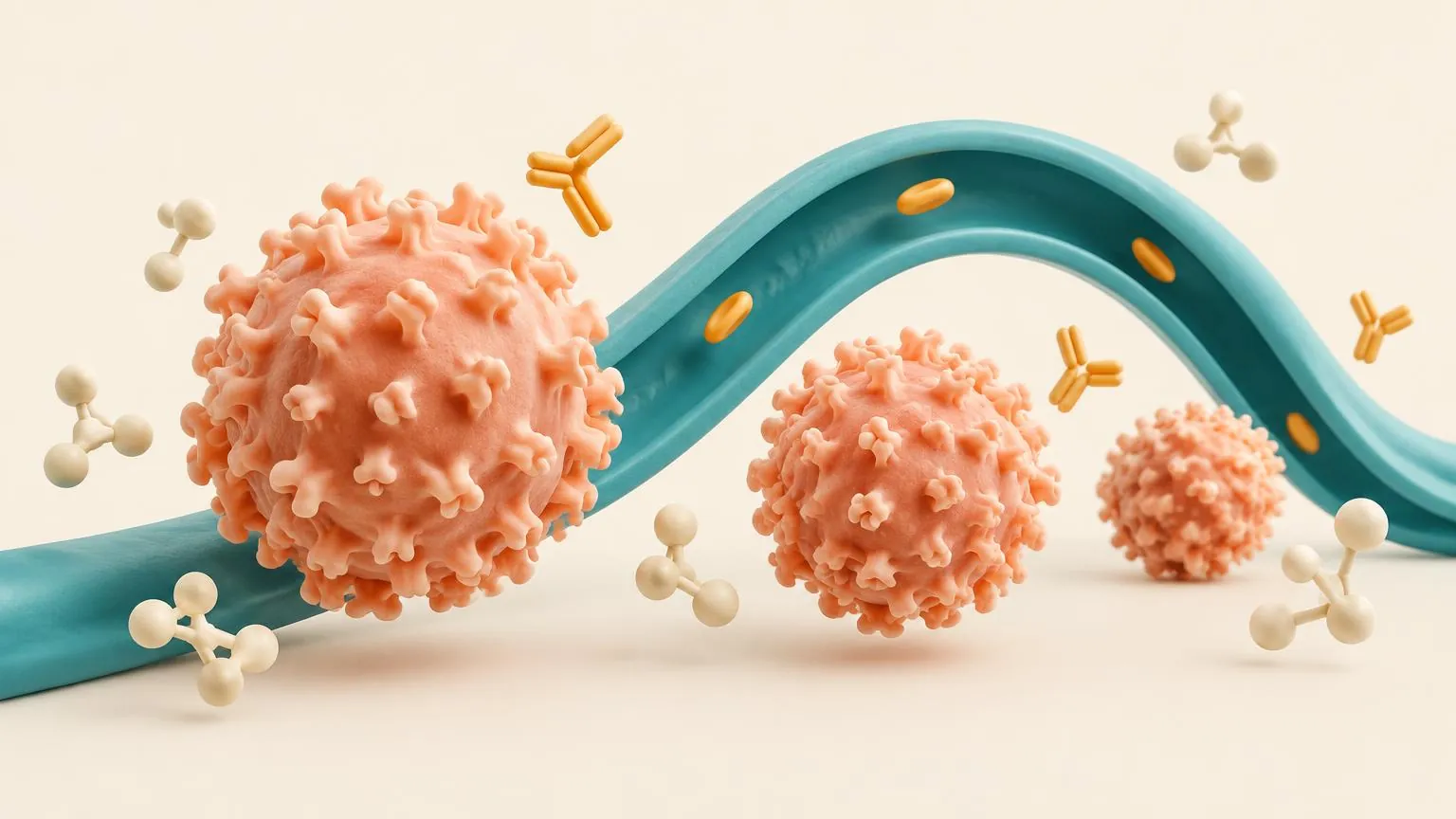
Immune cells that are multiplying in response to a target need a large supply of pyrimidines, building blocks of DNA. Teriflunomide blocks an enzyme called DHODH that cells use to make them. This slows the multiplying cells, while resting cells, which can recycle what they already have, are largely spared. In the TEMSO trial it reduced relapses by about a third compared with placebo.
Because its effect is reliable and moderate, teriflunomide has become a standard comparison for newer medicines.
Where medicines act
Fumarates
Dimethyl fumarate grew out of a treatment for psoriasis used in Germany, and it reduced relapses in two phase 3 trials. In laboratory studies it switches on the Nrf2 pathway, which protects cells against oxidative stress, and this raised hopes that it might also protect nerves. It also lowers the number of lymphocytes in the blood, and which of these effects matters most in MS is still debated.
Older immunosuppressants
Before the newer medicines, doctors used drugs that suppress the immune system broadly. Mitoxantrone, a cancer drug, slowed disability in a trial of people with worsening relapsing or secondary progressive MS, but its use is limited by the risk of heart damage and of leukaemia.
Ideas that made MS worse
Some medicines that work well in other immune diseases failed in MS or made it worse. Blocking tumour necrosis factor, a mainstay of treatment for rheumatoid arthritis, increased attacks in a trial in MS. Ustekinumab, which blocks two inflammatory signals and works in psoriasis, did not reduce new lesions. Daclizumab, which targets a receptor on T cells, was approved in 2016 and withdrawn worldwide in 2018 after cases of serious brain inflammation and liver damage.
These failures matter as much as the successes. They show that the immune process in MS differs from the one in arthritis or psoriasis, and that some inflammatory signals protect the nervous system as well as harm it.
Loading trial findings…
In the research now
Loading current research…
Key terms
- T cell
- A white blood cell that recognises a specific target and directs or carries out an immune attack.
- Lesion (plaque)
- An area of damage where myelin has been lost and the tissue scarred.
- Relapse (attack)
- New or worsening symptoms lasting at least 24 hours, without fever or infection to explain them.
- Placebo
- A dummy treatment that looks like the real one, used so that trial results reflect the medicine itself.
- Phase 1, 2 and 3
- The stages of testing in people: safety and dose, then an early sign of effect, then a large test of benefit.
References
- 1. Bar-Or et al. · Teriflunomide and its mechanism of action in multiple sclerosis. Drugs (2014)
- 2. O'Connor et al. · Randomized trial of oral teriflunomide for relapsing multiple sclerosis (TEMSO). NEJM (2011)
- 3. Gold et al. · Placebo-controlled phase 3 study of oral BG-12 for relapsing multiple sclerosis (DEFINE). NEJM (2012)
- 4. Fox et al. · Placebo-controlled phase 3 study of oral BG-12 or glatiramer in multiple sclerosis (CONFIRM). NEJM (2012)
- 5. Linker et al. · Fumaric acid esters exert neuroprotective effects in neuroinflammation via activation of the Nrf2 antioxidant pathway. Brain (2011)
- 6. Hartung et al. · Mitoxantrone in progressive multiple sclerosis: a placebo-controlled, double-blind, randomised, multicentre trial (MIMS). Lancet (2002)
- 7. FDA · Novantrone prescribing information (2000)
- 8. The Lenercept Multiple Sclerosis Study Group · TNF neutralization in MS: results of a randomized, placebo-controlled multicenter study. Neurology (1999)
- 9. Segal et al. · Repeated subcutaneous injections of IL12/23 p40 neutralising antibody, ustekinumab, in patients with relapsing-remitting multiple sclerosis. Lancet Neurology (2008)
- 10. Drug and Therapeutics Bulletin · Daclizumab withdrawn from the market worldwide (2018)
Next · Lesson 8 of 11
Resetting the immune system
Cladribine, alemtuzumab, stem-cell transplants and CAR-T cells.
Continue